- Vaitheeswaran Koil

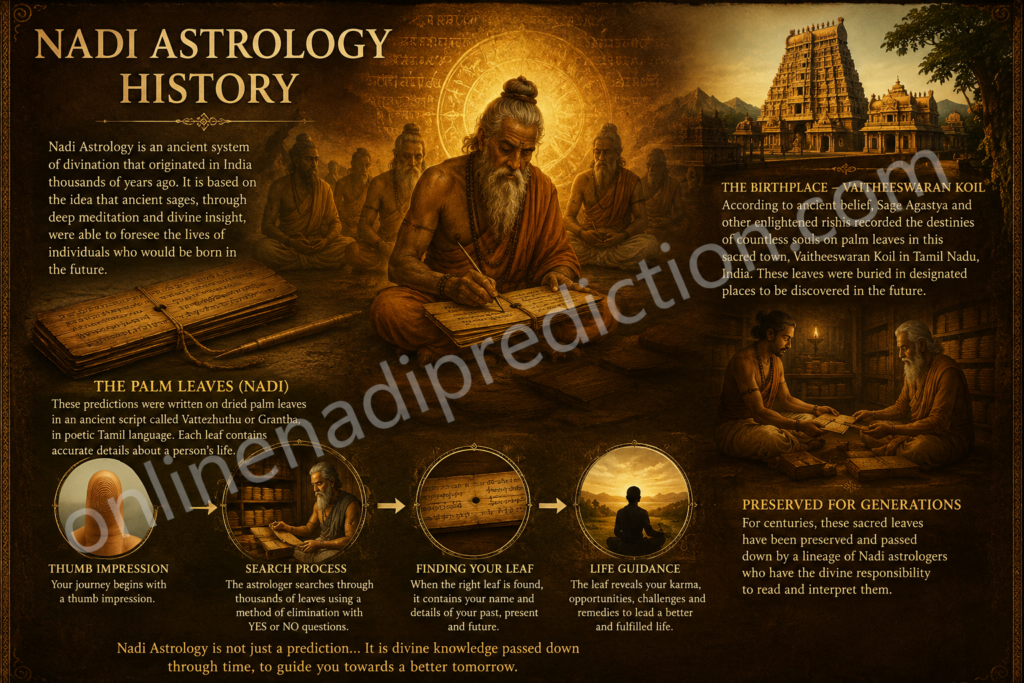
The History of Nadi Astrology
Nadi Astrology (Nadi Jothidam) is one of India’s oldest spiritual traditions, deeply rooted in the cultural heritage of Tamil Nadu. It combines ancient palm-leaf manuscripts, Siddha philosophy, and traditional methods of guidance.
The Origin of Nadi Astrology
According to Hindu tradition, thousands of years ago, great sages known as Rishis attained extraordinary spiritual insight through intense meditation and penance. Among them, Sage Agastya is the most closely associated with Nadi Astrology, although other sages such as Bhrigu, Koushika, Shukra, Vasishtha, and Kakabhujandar are also believed to have composed Nadi manuscripts.
It is traditionally believed that these sages perceived the life journeys of people who would seek their guidance in the future. They recorded this knowledge on dried palm leaves using ancient Tamil script.
The Palm Leaf Manuscripts
The manuscripts, called Olai Suvadi, were written on treated palm leaves using a metal stylus. The inscriptions were made in ancient Tamil scripts, including Vatteluttu. After engraving, a mixture of herbal oil and charcoal was rubbed into the leaves so the writing became visible.
Each manuscript traditionally contains guidance about topics such as:
- Birth details
- Family background
- Education
- Career
- Marriage
- Children
- Health
- Wealth
- Spiritual progress
- Suggested remedies (Pariharams)
Why Vaitheeswaran Koil Became the Center
The temple town of Vaitheeswaran Koil in Tamil Nadu became the most recognized center for Nadi Astrology because generations of hereditary Nadi-reading families preserved and interpreted these manuscripts there.
Over centuries, palm leaves naturally decayed, so they were periodically recopied by trained scholars to preserve their contents.
Historical Development
During the medieval period, the Chola kings are believed to have supported the preservation of palm-leaf manuscripts. Later, during the Maratha rule of Thanjavur (17th–18th centuries), many ancient manuscripts were collected and preserved in royal libraries, including collections associated with the Saraswathi Mahal Library.
Over time, some manuscripts came into the care of hereditary Nadi astrologer families, who continued the tradition of identifying and interpreting the leaves.
How the Leaves Are Found
Unlike conventional astrology, Nadi Astrology often begins with a thumb impression:
- Men generally provide the right thumb impression.
- Women generally provide the left thumb impression.
The thumbprint is used to classify the seeker into a category. The reader then asks a series of yes-or-no questions to identify the palm leaf believed to correspond to that individual.